Norse Vikings
Scandinavia
Combs are among the most common items found in Viking graves. Grooming a beard was a sign of pride and status.
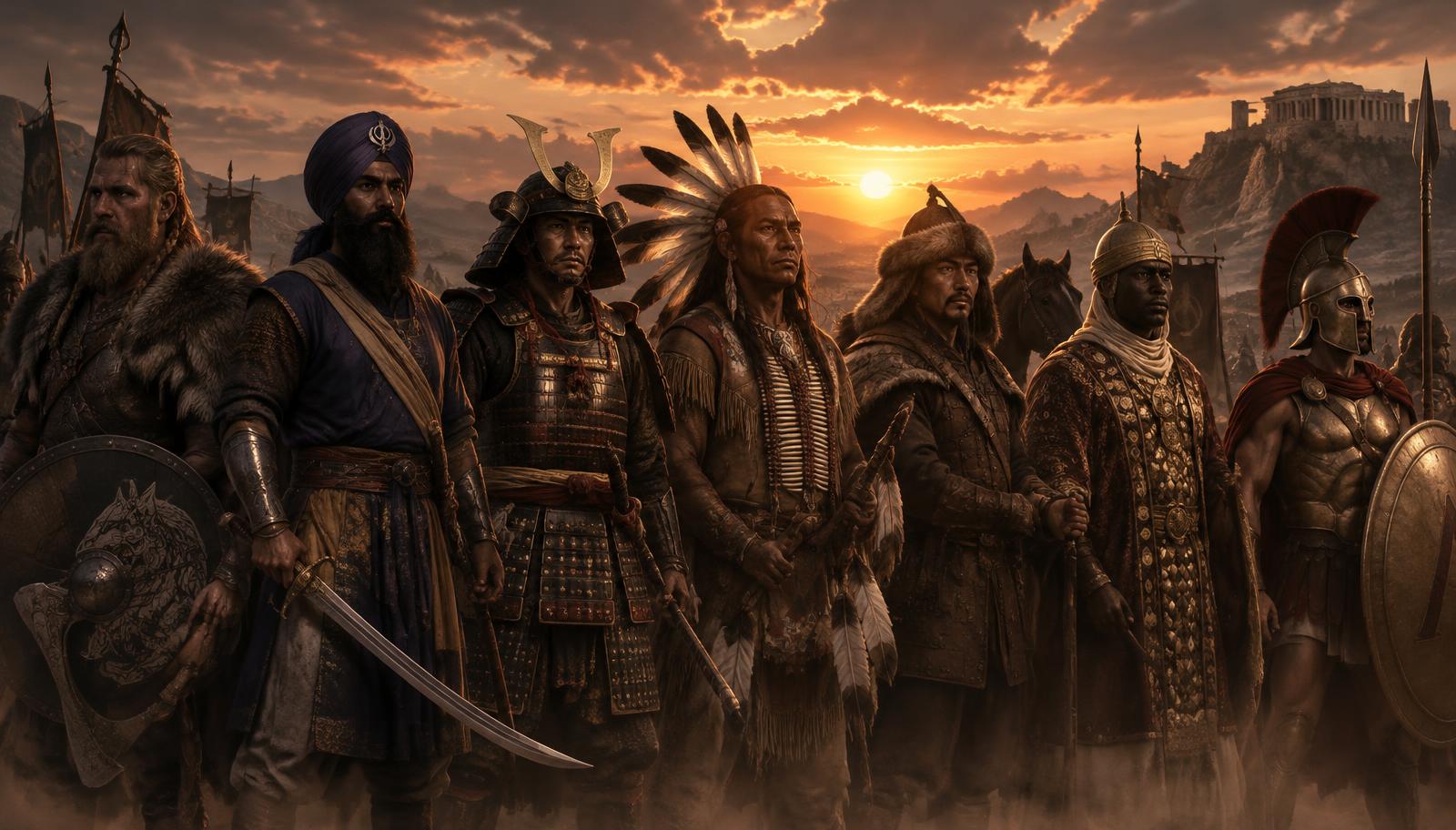
Ancestry · Warriors · Legends
Some wore mighty beards. Some never grew one. All of them were great. Here's the real history — from every corner of the world.
Your ancestry
How thick, where, and when your beard grows is mostly inherited. Look at the men in your family on both sides — that's your best preview.
Beard growth depends on how sensitive your hair follicles are to DHT, a hormone made from testosterone. Two guys with the same levels can grow totally different beards.
A 2016 study of more than 6,000 people in Latin America (Adhikari et al., Nature Communications) linked several genes, including EDAR, to beard thickness.
On average, beard density differs between ancestral groups. Many men with East Asian or Indigenous American roots grow lighter facial hair; many with Middle Eastern, South Asian or European roots grow denser. But variation inside every group is huge.
Warriors of the world
For some warriors, the beard was sacred. For others, it was shaved or plucked. What they shared was discipline, loyalty and courage.
Scandinavia
Combs are among the most common items found in Viking graves. Grooming a beard was a sign of pride and status.
Punjab, South Asia
Since 1699, keeping hair and beard uncut (kesh) has been an article of faith. Sikh soldiers served with honor in both World Wars.
Mesopotamia (Iraq)
Palace carvings show kings and warriors with long, carefully curled beards — a symbol of power and maturity.
Japan
Many kept light mustaches. Some armored face masks (menpō) even had horsehair mustaches added to look fiercer.
Central Asia
Often shown with thin mustaches and light beards — and they built the largest connected land empire in history.
North America
Many Native nations traditionally plucked facial hair. Legendary leaders like Crazy Horse were beardless and feared in battle.
Southern Africa
Under Shaka, Zulu warriors became famous for discipline, speed and training — proof that strength isn't about facial hair.
Greece
Ancient writers say Alexander the Great ordered his soldiers to shave so enemies couldn't grab their beards in close combat.
Gods & religious figures
How sacred figures are pictured comes from each tradition's art and writings. We share these with respect — every faith on this list is honored by millions.
Greek mythology
King of the gods, almost always shown with a full, curly beard.
Norse mythology
One of his many names, Síðskeggr, literally means "long beard."
Norse mythology
God of thunder, famous for his red beard.
Ancient Egypt
Gods wore a curved divine beard. Pharaohs — even Queen Hatshepsut — wore false ceremonial beards to show sacred authority.
China
A real general later honored as a god of loyalty and war, nicknamed "Lord of the Magnificent Beard."
Hinduism
The creator god is often shown with a beard, representing wisdom and age.
Judaism, Christianity, Islam
Traditionally pictured with a long beard in art across all three faiths.
Christianity
Usually shown bearded since around the 4th century — though some of the earliest Christian art shows him clean-shaven.
Islam
Islamic tradition describes him with a full beard. Out of respect, he isn't shown in images.
Sikhism
Founder of Sikhism, traditionally shown with a long white beard.
Greek mythology
God of the sun, music and healing — shown young and clean-shaven as the ideal of youth.
Hinduism
One of the most loved Hindu deities, always shown without a beard.
Hinduism
Hero-king of the Ramayana and a model of courage, shown beardless.
Hinduism
The powerful destroyer and transformer is usually pictured clean-shaven.
Buddhism
Siddhartha shaved his hair and beard when he gave up palace life — and is shown beardless.
Greek mythology
Early art gave him a beard; later art made him young and beardless. Same god, new look.
Great leaders
From Ethiopia to Haiti, Punjab to Japan — greatness came with and without a beard.
United States
Grew his famous beard in 1860 after an 11-year-old girl wrote him a letter saying it would help him win.
Ethiopia
Led Ethiopia to victory at the Battle of Adwa in 1896, keeping the country independent.
Ethiopia
Emperor known worldwide for his neat beard and for speaking up at the League of Nations.
Kurdish, Middle East
Sultan respected even by his enemies for his fairness and chivalry.
Sikh Empire, India
The "Lion of Punjab" united the region into a powerful empire.
Japan
Led Japan's rapid modernization and wore a full beard in later portraits.
Mongolia & China
Founded China's Yuan dynasty; his portrait shows a mustache and beard.
United States
Escaped slavery and became one of history's greatest speakers for freedom.
Macedonia, Greece
Built a huge empire before age 33 — and made shaving fashionable.
Rome
Most Roman leaders shaved until Emperor Hadrian made beards trendy.
India
Led India to independence through peaceful protest.
South Africa
Spent 27 years in prison, then became president and united a nation.
Hunkpapa Lakota
Spiritual and military leader who stood up for his people's land.
Haiti
Led the revolution that made Haiti the first nation founded by formerly enslaved people.
Venezuela, South America
Freed six modern nations from Spanish rule.
United States
Kept a mustache, no beard — and changed the world with his words.
What science says
Researchers have actually studied this (with adults). The short answer: a lot of women like some facial hair — but not everyone, and not always.
In a 2013 study (Dixson & Brooks), women rated heavy stubble as the most attractive look. Full beards were rated highest for seeming healthy and like a good future dad.
Research by Dixson & Vasey (2012) found beards make men look older, higher in status and stronger — which is why many people link them with confidence.
A 2014 study (Janif, Brooks & Dixson) found beards were rated more attractive when they were rare. When everyone has one, clean-shaven stands out more.
Preference isn't universal. Many people like a smooth face, and it changes with culture, age and personal taste.
What matters more than any beard
Being kind, confident, clean and yourself. A well-kept face — bearded or smooth — beats a messy one every time.